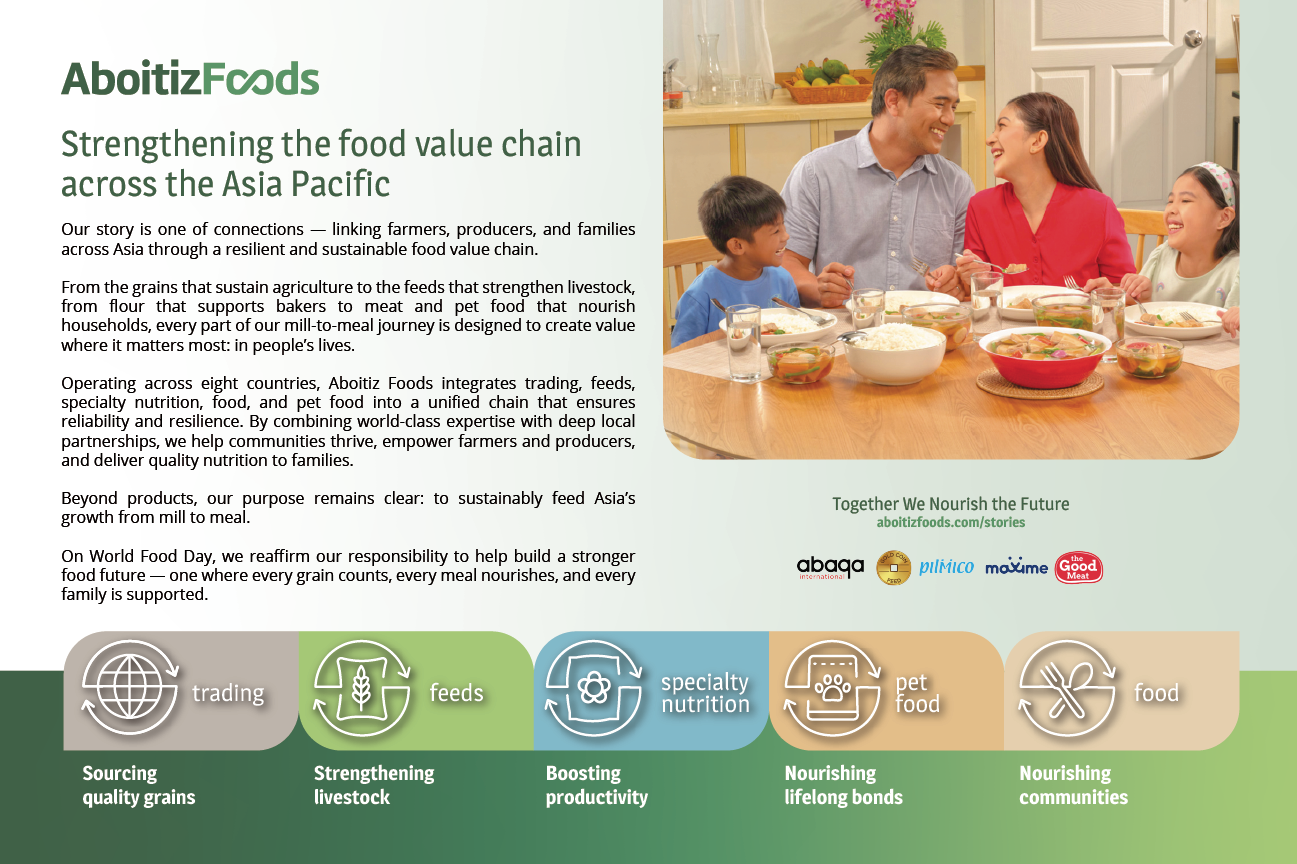
As we celebrate World Food Day, we at Aboitiz Foods highlight the importance of strengthening every link in the Asia Pacific food value chain — from responsible sourcing to sustainable production and nutrition. Guided by our purpose of sustainably feeding Asia’s growth from mill to meal, we continue to invest in innovation, collaboration, and people who ensure that food security, quality, and resilience remain at the heart of everything we do.
#TogetherWeNourishTheFuture
Frequently Asked Questions
What challenges is the Asia-Pacific food and agribusiness industry currently navigating?
The regional food and agribusiness sector is managing a convergence of pressures: rising demand alongside higher material costs, shifting consumer expectations, intensifying climate risks, and rapid digital transformation. Growth in this environment is no longer purely a question of scale – it demands adaptability, a commitment to social responsibility, and the operational resilience to weather industry cycles. Companies that thrive must balance expansion with purpose, building systems that are both efficient and responsive to the complex realities of feeding a growing Asia.
What is Aboitiz Foods’ most significant recent strategic move to strengthen its regional position?
Aboitiz Foods completed the full equity acquisition of Singapore-based Diasham Resources, a specialist in animal nutrition and health solutions. The acquisition expands the company’s footprint across key Asia-Pacific markets – including Thailand, Indonesia, China, Hong Kong, South Korea, Taiwan, Vietnam, Malaysia, and Bangladesh – through Diasham’s established distribution networks. By integrating Diasham’s expertise, the company strengthens its specialty nutrition portfolio and enhances its ability to deliver more targeted, science-backed solutions to customers across the region.
How is Aboitiz Foods driving innovation and operational efficiency across its value chain?
Two major initiatives stand out. “The Mill” is a company-wide product innovation platform that empowers cross-functional teams to challenge existing processes and develop practical improvements. On the technology front, Aboitiz Foods became the first company in the Philippines to implement Amazon Web Services Outposts in its manufacturing facilities, enabling real-time data processing, reducing operational latency, and strengthening systemic stability – translating factory-level efficiency into supply chain reliability and stronger customer trust.
How does Aboitiz Foods build capability among its partners and communities?
The company runs Agriconnect, a platform that brings together veterinarians, nutritionists, and technical specialists across swine, poultry, and aqua segments in the Philippines, China, Malaysia, Vietnam, and Indonesia. Locally, MasaGaling is a nationwide baking skills training program in the Philippines, while Project Synergea upgrades Brunei’s Institute of Brunei Technical Education Agro-Technology Campus to develop the next generation of food producers – reinforcing the principle that sustainable growth depends on the capability of partners and communities, not just the company’s own operations.
What does Aboitiz Foods’ approach to sustainability and CSR look like in practice?
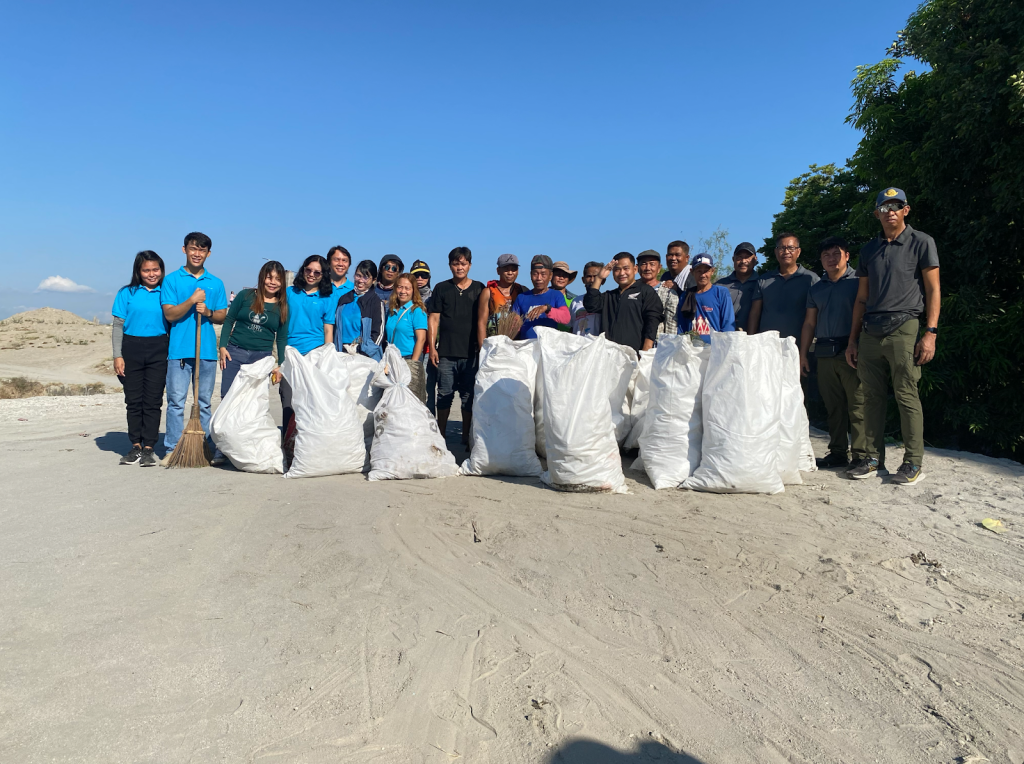
Aboitiz Foods’ sustainability work is anchored in the everymeal advocacy – promoting responsible choices across the food value chain – and aligns with the United Nations Sustainable Development Goals. A concrete milestone was exceeding the Philippines’ Extended Producer Responsibility Act plastic recovery targets by more than 300 percent in 2024. Across the region, initiatives range from recycling programs in China and solar lighting support in rural Malaysia to livelihood and education programs in Vietnam, demonstrating that regional expansion and community well-being are treated as mutually reinforcing, not competing priorities.