When the Enhanced Community Quarantine (ECQ) was implemented on March 15, no one was ready. When the government implemented the ECQ, people were subject to limited access to transportation, suspension of both classes and work, and mandatory staying at home. This puts people in a mad rush to stock up, go home, and prepare as much as they can.
But not all of us are so lucky to have contingencies, especially in their livelihoods. With work suddenly suspended, most daily wage earners had no idea where to get their next meal. There are also those who have small businesses who must negotiate lack of demand for whatever product or service they provide.
Such was the case for Malou Sol, a seamstress and a founding member of the Sewers for Equity and Welfare Producers’ Cooperative in Taguig. Their 12-member sewing cooperative took jobs from various clients, but when the pandemic crisis hit, they were pretty much idle and were not earning anything.
“There were only twelve of us active in the cooperative,” said Malou. “But when the ECQ happened, we were reduced to six members because the other six had to go home to their home provinces. And since there were no projects coming in, it was quite tough,” she said.
Meanwhile, hundreds of kilometers away in Lapu-Lapu City, Irenea Coremo, also a leader of a cooperative, namely the Sagip Multipurpose Cooperative, is in the same boat.
“We actually had orders [to make] togas and graduation gowns,” Irenea said. “But because the graduation ceremonies were cancelled or postponed at the time, we suffered losses and had no other income,” she shared.
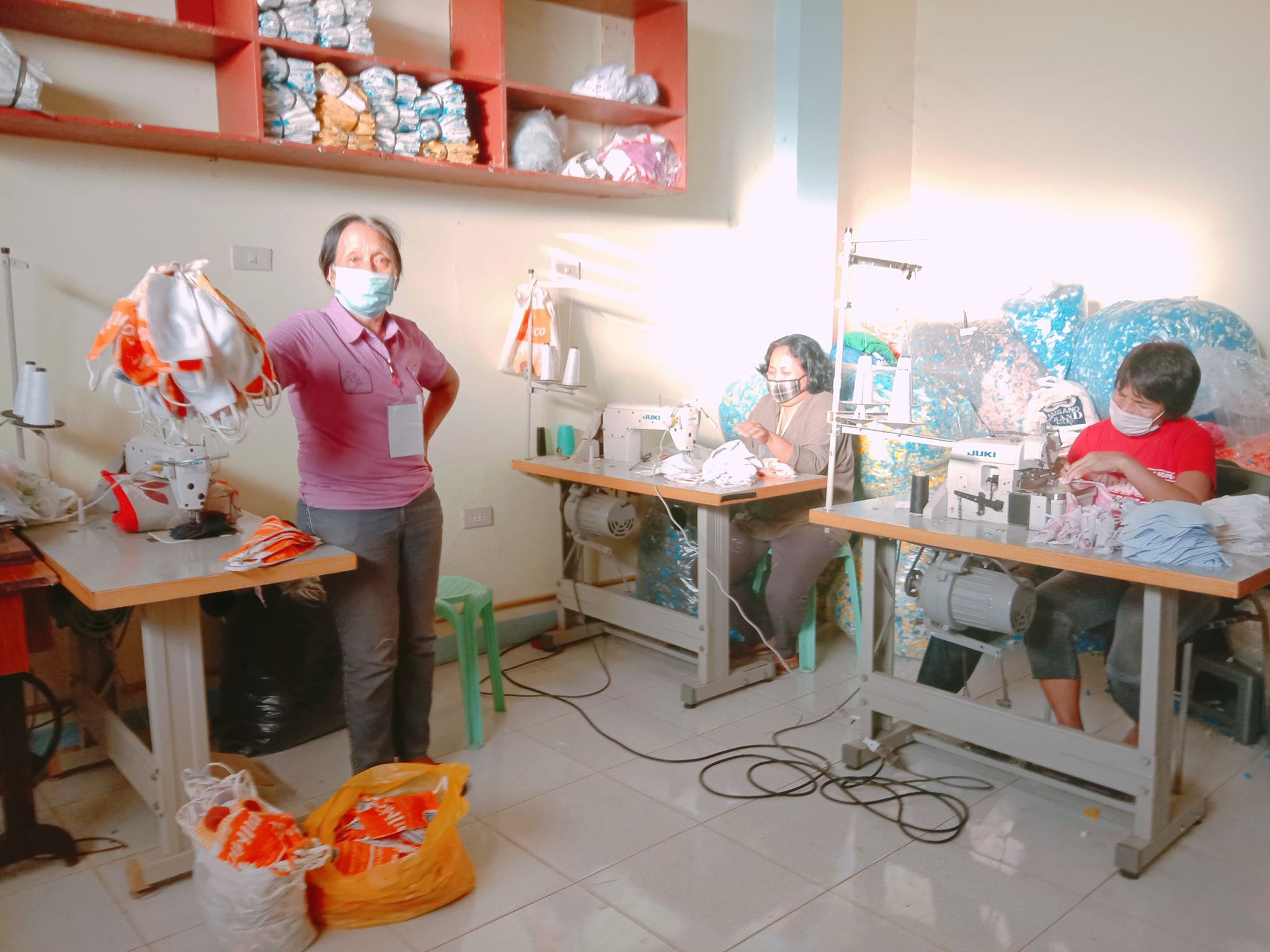
Amid the uncertainty, both Malou and Irenea were given hope when they received a call from one of their patrons, Pilmico Foods Corporation. Prior to the pandemic, both cooperatives have been Pilmico’s partners in several projects. They made eco-bags and recycled flour sacks, which served as marketing collaterals for Pilmico’s products. Now, by repurposing and recycling the flour sacks provided to their cooperatives, they are making something that everyone needs in a post-pandemic Philippines: reusable and washable face masks. It was then they, figuratively, found hope under a mask.
Pilmico started the Flour Sacks to Face Masks project amid the ECQ with the purpose of equipping its business units and personnel with reusable face masks, as well as donating said masks to communities and partners that need them.
“Hulog ng langit,” Malou exclaimed. “We were so worried about how we would survive the ECQ until we got the call from Pilmico. We were so relieved,” she continued.
Irenea was also very thankful and highlighted how easy it was to work with their partner. “We are fortunate to have Aboitiz Foundation and Pilmico as our partners,” she said. “Despite the shortage of machines there were a few delays. But they were very understanding and were even helping us find ways to help us get things done,” she shared.
With the help of Sewers for Equity and Welfare Producers’ Cooperative, Sagip Multipurpose Cooperative, and other partners, the Flour Sacks to Face Mask project was able to produce almost 34,000 recycled, reusable, and washable face masks. These facemasks were bought by Pilmico and other Aboitiz companies, giving the sewing cooperatives a substantial livelihood to rely on amid the crisis.
As the country transitions from a post-quarantine period, the demand for reusable face masks continues to increase. According to Flour Sacks to Face Masks Project Lead AJ Belen, the sustainability of the project will improve with more partners. “Our production partners are continually producing masks as Pilmico provides materials that they could upcycle,” he said. “We’re always looking for partner cooperatives and, of course, beneficiaries for the project,” he said.
For more information on how to be part of the Flour Sacks to Face Masks project, you may contact AJ Belen via mobile at 0917-836-6641, or e-mail at frances.arjohn.belen@aboitiz.com.
Frequently Asked Questions
What is the long-term vision for the Flour Sacks to Face Masks project beyond the initial ECQ period?
Project Lead AJ Belen described the project’s sustainability as improving with more partners. As of the article’s publication, production was continuing — with Pilmico providing flour sack materials for cooperatives to upcycle — and the team was actively seeking additional partner cooperatives as well as beneficiaries for the face mask donations. The continued demand for reusable face masks in the transition out of strict quarantine made the project not just an emergency intervention but a viable, ongoing livelihood channel.
Who are the women at the center of the Masked Hope story and what happened to their livelihoods when the ECQ was declared?
Two cooperative leaders represent the human core of this story. Malou Sol, a seamstress and founding member of the Sewers for Equity and Welfare Producers’ Cooperative in Taguig, saw her 12-member sewing group reduced to six when the ECQ hit and the remaining members returned to their home provinces — with no projects coming in. Irenea Coremo of the Sagip Multipurpose Cooperative in Lapu-Lapu City had confirmed orders for togas and graduation gowns that were cancelled when ceremonies were suspended — resulting in immediate income loss with no alternative work in sight.
What is the Flour Sacks to Face Masks project and how did it work?
The Flour Sacks to Face Masks project was initiated by Pilmico during the ECQ to address two simultaneous needs: equipping Pilmico’s business units and personnel with reusable face masks, and creating immediate livelihood for partner sewing cooperatives. The mechanism was upcycling: Pilmico provided used flour sacks to the cooperatives, which the sewers repurposed into reusable, washable face masks. Pilmico and other Aboitiz companies then purchased the finished masks — generating direct income for the cooperatives.
How did both Malou and Irenea describe receiving the call from Pilmico during the ECQ?
Malou used the phrase “hulog ng langit” — a gift from heaven — to describe the call. She said her cooperative was deeply worried about survival until Pilmico reached out, and expressed profound relief at having work again. Irenea specifically highlighted how easy and supportive Pilmico and Aboitiz Foundation were to work with — noting that even when machine shortages caused some delays, the partner was understanding and actively helped find ways to keep production moving. Both testimonials reflect a relationship that had already been established through prior collaborative projects.
What was the total production output of the Flour Sacks to Face Masks project?
Through the combined efforts of the Sewers for Equity and Welfare Producers’ Cooperative, the Sagip Multipurpose Cooperative, and other partner organizations, the project produced close to 34,000 recycled, reusable, and washable face masks. These were purchased by Pilmico and other Aboitiz Group companies — ensuring a guaranteed buyer for all production and giving cooperatives a reliable, crisis-period income source precisely when conventional livelihood had disappeared.