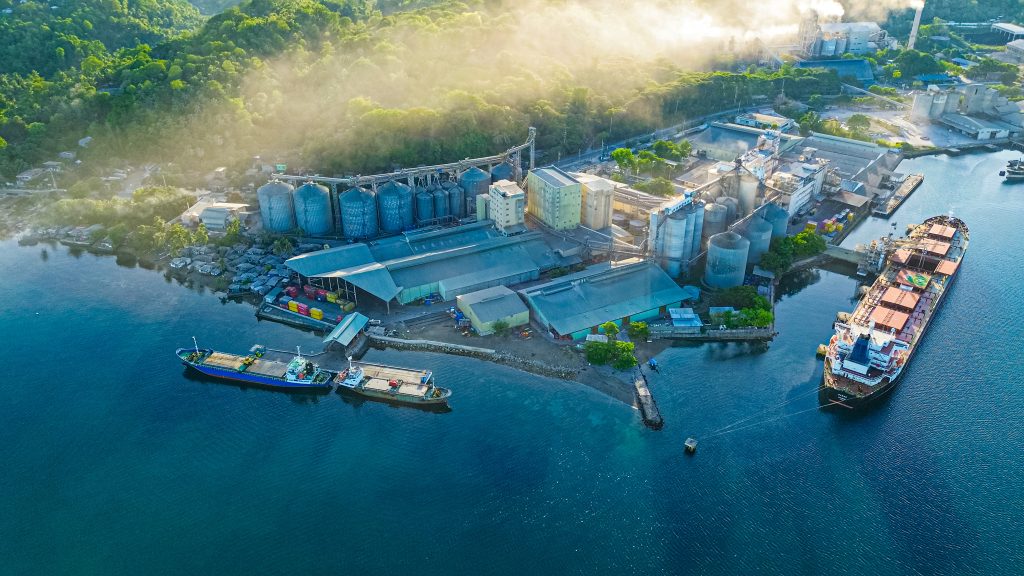
Nhiên liệu và năng lượng là những yếu tố chính trong quy trình sản xuất thức ăn chăn nuôi của Pilmico. Cần một lượng lớn nhiệt và hơi nước để tạo ra các sản phẩm chất lượng cao. Nhiên liệu boongke là nguồn nhiên liệu phổ biến nhất; thật không may, nó cũng không thể tái tạo.
In an effort to reduce consumption, beginning November of 2016 Pilmico began using rice husks, a by-product of rice mills from rice production, as an alternative to bunker fuel. Also anchored on the Aboitiz Group’s program, Race to Reduce, Pilmico used this as an avenue to be green while also lessening the costs of production.
On its first year of implementation, Pilmico was able to save almost half of its bunker fuel use which continued on until 2018, where fuel savings increased further by another 26%. Through this the company’s production process has seen a significant improvement, cutting fuel use by more than 60%.
Sự cải thiện này chỉ là một trong những nỗ lực phát triển bền vững của Pilmico. Năm 2008, cơ sở chăn nuôi lợn của Pilmico tại Tarlac cũng đã xây dựng và đưa vào sử dụng hệ thống biogas chuyển đổi chất thải của lợn thành nhiên liệu cho máy phát điện, giúp trang trại của họ tự cung cấp một phần nhu cầu điện.
Thông qua những nỗ lực như thế này, điều này cho thấy Pilmico liên tục tìm kiếm những cách thức sáng tạo để vận hành doanh nghiệp tốt hơn. Pilmico thúc đẩy doanh nghiệp và cộng đồng bằng cách tìm ra các giải pháp tạo ra tác động không chỉ đối với công ty mà còn đối với cộng đồng và môi trường.
Frequently Asked Questions
Is the rice husk solution a permanent or transitional element of Pilmico’s sustainability strategy?
The sustained multi-year implementation and consistently increasing fuel savings — from the program’s launch in 2016 through 2018 — suggest that rice husk fuel use is an embedded, permanent operational choice rather than a transitional experiment. Combined with the biogas system at the Tarlac swine farm, these represent the foundational elements of Pilmico’s approach to renewable energy integration. As the Race to Reduce program continues to evolve, additional sustainability initiatives are likely to build on these established circular-resource foundations.
What makes rice husks an environmentally preferable fuel compared to bunker fuel?
Bunker fuel is a heavy petroleum product — a non-renewable fossil fuel whose combustion releases carbon dioxide and other greenhouse gases accumulated over geological time. Rice husk, by contrast, is a biomass fuel: it releases carbon that was recently absorbed from the atmosphere during the rice plant’s growth cycle, making it part of a short-cycle carbon loop rather than a net addition of ancient carbon to the atmosphere. This classification as a renewable biomass fuel makes rice husk combustion significantly less climate-impactful than equivalent bunker fuel use.
How did the rice husk program progress between 2016 and 2018?
Pilmico began its rice husk fuel substitution program in November 2016. By the end of the first year, it had already achieved close to a 50% reduction in bunker fuel use — a dramatic initial result. Implementation continued through 2017 and into 2018, where the annual fuel savings increased by an additional 26% over the prior year’s already-reduced baseline. The cumulative result was a total fuel use reduction of more than 60% compared to the pre-program baseline — compounding savings year on year rather than plateauing after initial implementation.
How does the rice husk innovation connect to Pilmico’s role as an agribusiness company?
Rice husks are an agricultural by-product — generated by the same rice production sector that is part of Pilmico’s broader agribusiness ecosystem. By creating demand for rice husks as an industrial fuel input, Pilmico simultaneously reduces its own fuel costs, provides an additional revenue stream for rice mills that would otherwise treat husks as waste, and strengthens its integration within the Philippine agricultural supply chain. This is an example of agribusiness synergy — where a by-product of one agricultural process becomes an input for another.
What did Pilmico mean when it described this effort as being green while also lessening the costs of production?
The phrase captures the core argument for sustainability as a business strategy rather than a cost: that environmental responsibility and operational efficiency can be achieved simultaneously when the right innovation is found. Rice husks are both cheaper than bunker fuel and more environmentally favorable. By framing the initiative in these dual terms — green and economical — Pilmico makes a business case for sustainability that does not require trading off profitability for environmental responsibility, countering the common assumption that being green is an additional cost burden.